|
9. KISSAMOS - PALEOCHORA (see Map
)
(Through Episkopi, Astrikas)
Head east and as soon as you are out of Kasteli turn right
in order to get on the old road (A3) that goes to Kolimvari
(there is a Gr/E sign at the intersection that says “Hania
Old Road”). About a couple of kilometres after Plakalona
turn right, following the direction of Nochia.
(You will see a Gr/E sign at the intersection pointing you
to the village). About 1500 metres after the intersection -
and a little after you have passed Nochia - you will see another
intersection with a Gr sign directing you to Gerakiana, Drakona.
Turn left, and follow the road (A3) as it winds up and down
some small hills covered with olive groves and vineyards. When
you get to Drakona you will notice that the village itself has
nothing special to see. Yet 200 metres after its south exit
there is a very narrow path - so narrow, in fact, that a bike
can hardly follow it - which leads to the chapel of Aghios Stephanos,
just 150 metres away. This is a small Byzantine chapel that’s
certainly worth visiting. Built in the beginning of the 10th
century on the side of a small ravine that today is full of
plane trees, it has thick stone walls and a vaulted roof and
it is decorated with some exquisite wall paintings that are
quite well preserved.
As you continue southward, you will see a Gr/E sign just before
Episkopi, which directs you to the Byzantine church of Michael
the Archangel
(otherwise known as “The Rotonda”).
It is a very imposing church, which once served as an Episcopal
seat (2nd Byzantine period, 961 - 1204 AD), and it is like no
other in Crete. Its unique architectural feature is its dome,
built in five successive levels. Judging from the few surviving
parts of the paintings, such as the face of the archangel ,
its decoration must have been very impressive. Also impressive
is the carved marble font with the two seats. The excavation
of the area has revealed that religious worship in this place
must have been an ongoing practice for at least 1500 years;
the church was apparently built on the ruins of an earlier basilica,
possibly of the 5th century, whose foundations (as well as a
part of a floor mosaic) have survived to this day. Currently,
the Rotunda is undergoing extensive restoration work, both on
the inside and on the outside. Despite the fact, the people
from the surrounding villages continue to visit it, and they
never leave without lighting a candle.
If you plan to spend a night in the area, the best place to
camp is the plateau at the east side of the impressive Rokka
gorge. To get there, go through Astrikas, and take the dirtroad
(D3) which you will see about 400 metres after the south exit
of the village. (It is just opposite the Panethimos intersection
and it goes west). The road goes through some olive groves and
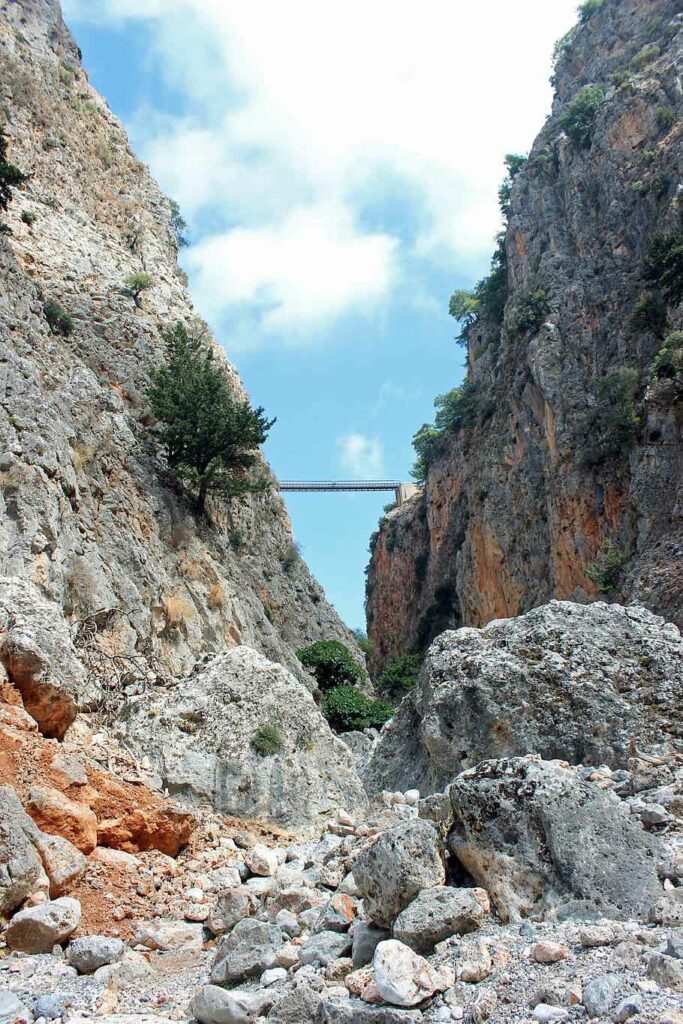
ends before a steep precipice just above the gorge. The place
where it stops will charm you with its serenity and panoramic
view ,
especially in the direction of the Kissamos Gulf and the village
of Rokka. For those that would rather stay in a room, there
is a new guest house in Astrikas. Also, this village is famous
for the "Biolea"
brand of Organic olive oil from Astrikas Estate in Crete, pioneering
a renewed interest in the authentic traditional stone ground
and cold pressed method of olive oil extraction.
To continue your trip toward Paleochora, you can take one
of the many fairly smooth dirtroads (D3) that start from Glossa,
Vassiliana or Zimbragos and take you to the main (asphalted)
road. The most interesting one starts at Zimbragos. You will
probably have a hard time finding its beginning, so ask someone
pou ìne o chomatòdhromos ghià Kakòpetro
(where is the dirtroad leading to Kakopetro). That road goes
through a beautiful small gorge and takes you to the main road
just east of Kakopetro. From here you can continue south on
the main road (A2), and you will get to Kandanos and then Paleochora.
However, you must drive very carefully; even though you are
on the main road, the asphalt is very slippery, the signs are
totally inadequate, and the road is too narrow to accommodate
the heavy traffic.
The above route is recommended for street bikes. But if you
have an off-road bike, you can take an alternative route after
Episkopi, one that will take you through the mountains and offer
you the most wonderful panoramic view of the entire Hania prefecture.
The Voukolies - Sembronas - Palia Roumata part of it could in
fact be rated among the best three mountain routes in Crete.
The desolate landscape, the incredible scenery almost during
the entire trip, the great places to camp along the way, and
the very good condition of the dirtroad (D2 / D3), all contribute
to this rating.
To follow this route, go east once you get to Episkopi and
take any of the roads that will take you to Voukolies. In Voukolies
you will see a road (A3) to your left, which goes toward Sirili
in the northeast. (There is a Gr sign at the intersection that
says.... This is the starting point of our route, so reset your
counter in order to follow Road Book 1. Turn left on this road
and after 200 metres, in fact right after a small cement bridge,
turn right on the narrow concrete-paved road that you’ll
see. (There is no sign to direct you). This road goes through
an area with orange and lemon trees, and after about 1 km it
turns into a dirtroad (D3), climbs through the olive groves,
goes through the half-deserted Kafouro, and offers a great view
of the Tavronitis valley. All around, the mountain slopes are
covered with bushes, and there are gorges with thick clumps
of plane and chestnut trees. After 9 km you will be at an altitude
of 800 metres, at the highest point of the route, and you will
be driving just a few metres below the peak of the mountain
and enjoying the truly panoramic view. The view to the north
is particularly charming; you can see the entire Gulf of Hania,
the Akrotiri peninsula to the east and the Rodopos peninsula
to the west. And if you feel like an eagle, you won’t
be the only one; just look around, and you may well see a family
of four eagles flying slowly and majestically around the Plataniani
peak (900 metres) where they have their nests... If you feel
like camping here, there is a wonderful small plateau just a
little bit further on the way, at an altitude of 750 metres.
After the plateau, the road goes along the mountain ridge, offering
the most spectacular view. It eventually leads to the Hania
- Sougia road, which it meets right where the first of the area’s
three roadside coffee shops is (the one furthest to the north).
Unfortunately, there is no sign at the intersection for those
that would like to do this route backwards and to get on this
dirtroad as they travel from Sougia to Hania. The only mark
that could help you is a small white building. It is situated
exactly where the dirtroad starts, and on the wall it has a
big “WC” written with green paint...
This concludes the first part of this beautiful mountain route.
About 200 metres further, you will see a Gr sign directing you
to Sembronas. Turn right and prepare for the second, equally
impressive part of the route. Just before the first of the five
spread out settlements that make up Sembronas, you will see
a dirtroad to your left with a small handwritten sign. The sign
says Drakouliana, Aghios Ioannis, Apopigadi, Palia Roumata,
and in English it says “Palia Roumata.” Here you
turn right and reset your counter once again. For the next 500
metres the road goes through a cultivated area, climbing to
Drakouliana. When you get to Drakouliana turn right. (There
are two Gr signs at the intersection pointing you to Aghios
Ioannis and Palia Roumata). After the last house of the settlement
- at kilometre 1 - you will run into the gate of a fenced pastureland.
Open the gate, go right in, and close it behind you. The landscape
from here on becomes increasingly wild, and it is full of shrubs
and gorges with thick clumps of plane trees. The road (D3) is
generally “decent,” with the only exception of two
or three sharp turns with gravel. It goes uphill and at some
point - kilometre 4, altitude 800 metres (the highest in the
route) - it splits. At the intersection you will see a handwritten
sign that’s written half in Greek and half in English.
One arrow points left, towards Aghios Ioannis, and another arrow
points right toward “Palia Roumata.”
As mentioned, our route goes through Palia Roumata, so here
you must obviously turn right. However, if you happen to arrive
at this point when it’s about to get dark, there is no
better place to spend the night than the chapel of Aghios Ioannis.
It is a beautiful stone-built chapel at the edge of a cliff,
only 2.2 km from the intersection, and it has a paved courtyard
with a wooden roof and wooden benches, offering the weary traveller
a spectacular view of the White Mountains. If you’d rather
not sleep outdoors, there is also a small room with a bed right
next to the chapel, which is all yours (unless of course somebody
was there before you). Finally, there is a fountain with ice-cool
water, straight from the spring!
To continue toward Palia Roumata, you make a right turn at
the Aghios Ioannis - Palia Roumata intersection, and you follow
the road as it goes downhill. At kilometre 5.5 you will pass
a col from where you have a great view to the west, a view reaching
as far as the Gramvoussa peninsula. At kilometre 9 you will
start passing through some small rural settlements, and at kilometre
11 you will encounter the concrete-paved road that connects
Palia Roumata and Micheliana, where you must turn right. The
main square of the village is only 1 km away.
Like all villages in the area, Palia Roumata
is unaffected by tourism because it has nothing to do with
the classic itineraries of most tourists. Its economy is clearly
based on farming, and more specifically on the production of
olives and olive oil. There is a good kafenìo hidden
in a small alley, where you could try some very tasty Cretan
specialties, but do not confuse it with the kafenìo at
the main square. When you have walked around the village, get
back on the road - no longer a dirtroad but an A3 - and follow
it till the place just outside Kakopetro where it meets the
main road that leads to Paleochora.
As you continue southward on the main road, you will pass through
the large village of Kandanos with its many taverns and coffee
shops. If you visited the place in the summer of 1941, the only
thing you would see here would be a marble column informing
the world - in both Greek and German - that:
“At this site stood the village of Kandanos. It was destroyed
in compensation for the murder of twenty-five German soldiers.”
In no other instance of the second world war did the Germans
show such a raging desire for revenge. They destroyed an entire
village and shot every person arrested, because the peasants
put up a fight. A second sign went even further:
“Because the men, women, children and priests dared to
resist the Great Reich, Kandanos was levelled to the ground
and will never be rebuilt.”
Kandanos was rebuilt and grew into a beautiful small town.
Yet its main square still has the column with the Nazi inscription,
a permanent reminder of human stupidity and beastliness.
After Kandanos you continue southward through the Kakodikian
ravine and as with the street route you reach Paleochora.
If, however, you cannot get enough of off-road routes and have
refused to drive on asphalt, there is still another option before
you reach Kandanos. When you get to Floria, you will see a dirtroad
to your right and a Gr sign at the intersection that says Sassalos
7. If you turn here and follow the road to Sassalos, you can
continue until Paleochora following route 8.2. Here is a quick
outline of the Floria - Sassalos route so that you don’t
get lost: At kilometre 2.2 you will see an intersection where
you have three options. Here you turn left and go down the west
side of the mountain. At kilometre 3 you pass a small village
called Selia. At 4.3 you will see a dirtroad going up the mountain,
but you ignore it and continue straight. At 4.8 you will pass
another small village called Maneriana (this is in fact one
of the Sassalos settlements) and you will see Sassalos, which
is built in a ravine. At 5 you will see an intersection, where
you turn left and go straight to Sassalos. (The dirtroad on
the right leads to the picturesque Pirgos, another one of the
Sassalos settlements, and from there to the asphalt road just
north of Sassalos).
| Source of the
information on this page : “Unexplored Crete”,
Road Editions. For more guidebooks and maps of
Greece, click here.
|
 |
|