|
8. KISSAMOS - PALEOCHORA (see Map
)
(Through Topoliano gorge)
Take the old road to Kolimvari in the east of Kasteli, and
when you get to Kaloudiana turn south (in the direction of Topolia).
This route is a classic for most people who wish to get from
Kasteli to Paleochora, because it promises a first encounter
with the famous Cretan gorges.
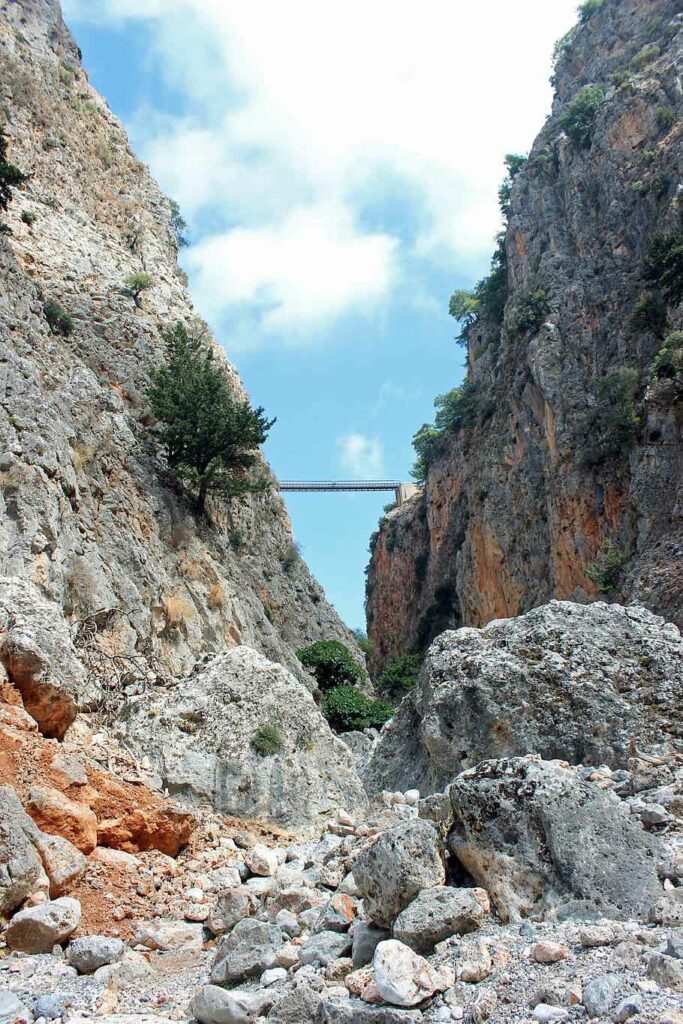
And indeed, the Topoliano gorge ,
through which it takes you, is quite impressive; a deep ravine
stretching over an area of 1.5 km, it has very steep limestone
walls (sometimes as high as a hundred metres) full of small
and inaccessible caves, while its floor is covered with beautiful
plane trees. The road (A3) is carved on the west side of it
and it is very narrow. (At one point there is even a tunnel,
which is one of two or three on the entire island). It also
has many turns without visibility, so although the scenery in
the gorge is indeed very attractive you should always keep an
eye on the road!
Many tourist guides mention the cave of Aghia Sophia as an
impressive sight. In reality, it is a rather shallow cavity
in the rock without much interest, and it is full of garbage
thrown by the deceived tourists and never collected by the Greek
authorities. There is also a small church at the entrance of
the cave which looks more like a decrepit hut.
At both ends of the gorge there is a village - Topolia in the
north and Koutsomatados in the south - with many Rooms to Let
and even more restaurants. These are concentrated on the main
street in order to attract the passing tourists, but they are
not worth much. After Koutsomatados you have two options. You
can take Route 8.1 and travel on an asphalt-paved road (A3),
or you can take Route 8.2 and travel mostly on dirtroads (D3).
Both routes will take you to Paleochora.
Koutsomatados - Voutas - Paleochora
The road (A3) from Koutsomatados to Strovles goes through a
typically rural area full of olive groves and small hills. Approximately
one kilometre after Strovles you will see an intersection with
a sign (Gr) that says “BÔ×Ù¿˜
15” (Voutas 15). Turn right (south) on the road (A3) that
climbs the mountain and keep going. The asphalt is excellent,
the turns are great, and you will be tempted to drive fast.
Although there are no signs, the turns are not dangerous and
there is always a protective bar by the roadside.
You can ride all the way to Archondiko with excellent conditions
- the road is one of the best mountain roads in Crete - and
you will have the chance to see some beautiful White Mountain
scenery. Right after the pass at the north side of Mount Kendoukles,
at a height of eight hundred metres, a wonderful picture appears
before your eyes: at your feet the valley of the Pelekaniotis
river, which is covered with olive trees, and in the west the
villages of Sklavopoula. When you reach Voutas, the largest
village in the area, you have again two options. If you want
to drive on asphalt, follow the Gr/E sign directing you to Paleochora
and turn left; you will go down the mountain, driving through
the olive groves at the east side of a ravine, and you’ll
arrive in Paleochora in no time.
But if you want to visit the charming Sklavopoula area and
do not mind driving on good dirtroads (D1 / D2), follow the
Gr sign that says Sklavopoula 7 and turn right. You will see
many mountain villages - Kalamios (at the end of an asphalted
road), Sklavopoula, Sphakia, Maniatiana (the starting point
of a dirtroad leading to Elafonissi in the west), Vathirrouma,
Azogires and Aghii Theodori - and they are all very picturesque
and full of hidden charms awaiting a discerning eye. The route
is also very pleasant, taking you through beautiful mountain
slopes and offering some lovely scenery. After Aghii Theodori
the road continues southward, going downhill, until it takes
you to a seaside village, Koundouras, planted in the middle
of an area with very large greenhouses. Here you turn east on
the main coastal road (A3) and follow it all the way to Paleochora.
Koutsomatados - Sassalos - Paleochora
Once in Koutsomatados, turn left (east) on the road that leads
to Sassalos (you’ll see a Gr/E sign at the intersection).
The road goes downhill, passing through several olive groves,
and takes you straight to the heart of the village. It is a
very picturesque village, built at the bottom of a ravine with
lush vegetation, but its only inhabitants are unfortunately
a few old people that have refused to leave their homes for
a larger town. At the two kafenìa of the village, the
old men gather and tell stories. It is worth stopping here for
a simple meal and a glass of raki or red wine. (The latter,
by the way, is produced locally and has an excellent taste).
A chat with these simple mountain people will certainly make
your day.
After Sassalos, the road (D2) continues southward, following
the course of the river that flows through the gorge. It goes
through a beautiful area full of plane trees and takes you to
a small village called Milones. There are no sharp inclinations,
so this entire route is good for walking or bicycling. If you
like, you can pitch camp in many places, as the whole area invites
camping. About one kilometre after Milones the road splits.
Turn left and you will soon be on the main road, at a point
just north of Dris. A couple of kilometres after Dris you will
see a dirtroad (D2) to your right - there is a Gr sign at the
intersection that says Kopeti. Turn right, and as soon as you
cross the river turn left. This will give you the chance to
enjoy a very pleasant route
alongside the west bank of the Kakodikiano stream. The scenery
includes thick olive groves and a dozen hamlets with beautiful
stone-built houses.
Unfortunately, most of these houses have been recently abandoned,
and it is only when the olives are picked that people come and
stay. All the other months, they are completely deserted.
The dirtroad you are on will eventually take you to Vlithias,
a small village with a Byzantine church in its cemetery. This
dates from the 14th century, and it is dedicated to Christ the
Saviour (Christòs Sotìras). It has some beautiful
wall paintings that are worth seeing, so follow the sign (Gr/E)
on the main road and you will soon be there. From here on you
simply continue on the main road (A2) that leads to Paleochora.
Raki (also known
as “tsikoudia”)
It is impossible to visit Crete and not be treated to a
few glasses of raki! Raki is the national drink of the Cretans.
It is produced in practically every household, with a ritual
that takes place at the courtyard, and despite the fact
that it’s a family thing rather than an industry the
production is massive! There is no home without a pitcher
or a small barrel of raki, and all through the day people
drink small glasses of it, usually with friends. The custom
is to accept the first couple of treats, to
raise your glass and say stin ighià sas (“to
your health”), and to toss it down. If you are not
used to it, though, or if you are on an empty stomach, do
not drink more than two glasses, or you are going to find
yourself in a state of tipsiness (or downright intoxication!)
The distillation
ritual usually takes place in the evening. They light a
big wood fire and heat an old copper cauldron in which they
place the stèmfila (the left over parts of the treaded
grapes whose juice has been made into wine) along with aromatic
herbs collected from the fields. The vapours are channelled
into a spiral tube that goes through a barrel of cold water,
they are condensed, and the raki drips into a ceramic jar
that is half buried in the ground.
The peasants gather in big parties around the cauldron,
and they sing and dance. They also consume large quantities
of raki, freshly produced and tempting. The ritual has remained
unchanged through the centuries, and if you happen to run
into a group of folks engaged in it you should consider
yourself welcome and prepare for a MANQUE TEXTE |
| Source of the
information on this page : “Unexplored Crete”,
Road Editions. For more guidebooks and maps of
Greece, click here.
|
 |
|