|
4. HANIA - HORA SFAKION (see Map
)
In contrast to the “tourist craze” prevailing on
the entire coast west of Hania and the equally crazy situation
in Georgioupoli, which is fast spreading to the Almiros bay
area too, the Vamos peninsula will delight you with its peaceful
beauty and unique landscapes.
The lack of beaches to swim and the new national road which
cuts the peninsula off from the rest of the island are the two
main barriers that have kept the hordes of tourists away and
have made it possible to save the region from tourist development.
As a result, the traditional ways of the Cretan farming community
have remained intact. 
On this low rocky peninsula, some twenty small villages are
nested, truly charming with their stone-built houses and narrow
cobbled streets, and full of the wonderful smell of home-cooked
food and the sound of playing children. Yet many houses have
been abandoned and neglected by their “modern” owners
who preferred the profitable tourist beaches to the exhausting
farm labour and the isolation of the village. Fortunately, many
of these houses have been bought - often at bargain prices -
by foreigners who seem to appreciate them more, and instead
of lying in ruins they have been carefully and lovingly restored.
To enter this beautiful area, exit the National Road twelve
kilometres outside Hania and turn left at the junction leading
to Kalami and Kalives. If, however, you decided to visit ancient
Aptera first (a wise choice!) you can continue south of Megala
Chorafia to Neo Chorio (the name means New Village, but the
village was actually visited by Pashley in 1834) and from there
you can head east towards Armeni on a road lined with huge eucalyptus
trees. You will at some point encounter the National Road and
cross under it. When you arrive at Kalives you’ll see
that all roads crossing the peninsula begin here.
Kalives (the word is Greek for “huts”) is exactly
the opposite of what the name suggests. It’s a large noisy
village with a lot of traffic, much like Kalami which lies three
kilometres to the west. These two places are the only ones that
have been infected by “tourist fever,” mainly because
they are situated to the right and left of a long beach, which
happens to be the only good place to swim in the peninsula.
Somewhere along this beach, or perhaps a little closer to Almirida
in the east, stood the ancient town of Ippokoronion, one of
ancient Aptera’s two harbours. This is also where the
Arab conquerors of Crete landed their troops in 826 AD, a “performance”
repeated some thousand years later by the Egyptians, Turkey’s
allies. During the latter attack, the local people fought back
with iron determination and the beach was filled with dark corpses.
Today the beach is filled with dark bodies every summer, which
the locals also “attack” with iron determination.
Though less crowded, Almirida has also its share of tourists,
concentrated around a small beach which is surrounded by many
country houses, taverns and Rooms to Let.
At the entrance of the village, you will immediately see to
your left the remains of an old Christian basilica with lovely
floor mosaics.
From here on starts an interesting route (A4), which will
take you through the charming villages of Plaka and Kokkino
Chorio and all the way to cape Drepano, the tip of which is
inaccessible due to the presence of an army camp. Continue to
the south towards the attractive Drapanos, Palialoni and Kefalas,
and make a stop at the Likotinara village square to enjoy an
impressive panoramic view of the Almiros bay and Rethimno. Then
take the road to Selia and Amigdali and continue until Vrisses.
From here you can head for Sphakia.
Vrisses is the starting point of an impressive route (A3) through
the eastern side of the White Mountains, which goes through
the Sphakia mountain area and ends at the southern coast of
Crete and the Libyan sea. This route is popular and very scenic,
and the road is asphalt-paved and quite decent, but one needs
to be careful of the many sharp U-turns and the heavy traffic.
Approximately four kilometres south of Vrisses you will spot
a road (A3) heading east (toward Alikambos). It’s worth
making a detour and following this road. At Alikambos you will
see a dirtroad (D3), also heading east. This stops suddenly
after a while, but it is worth taking if only to enjoy a magnificent
view of Lake Kourna and of the entire bay of Almiros with its
sandy beaches. On your way back you will also enjoy a great
view of the eastern side of the White Mountains.
Halfway the distance to Chora Sfakion, and about seven hundred
metres above sea level, lies the Askifos plateau with four small
villages surrounding it. Of these, Ammoudari is the most “advanced,”
having a gas and tyre station as well as a few restaurants and
Rooms to Let. Since very few people wish to spend the night
here, you shouldn’t have any trouble finding a room. Your
best choice, however, is the rooms of “barba” Ieronymos
Gialedakis, located right above his tavern near the gas station
(and note that there is also a shed for bikes!)
“But why stay at Ammoudaria” you may ask. Well,
there are plenty of reasons. You can stay for the cool, refreshing
nights and the star-studded sky. You can stay for the great
walking routes:
one to the west, leading to the Agriokephala peak and the Tavri
refuge at a height of 1200 metres; one to the east, taking you
to a fortress and peak Halara at about 1100 metres; one to the
north, crossing the impressive Katre gorge; and one to the south,
leading to Asphendou, and from there to Frangokastelo through
the Asphendiano gorge. Finally, you can choose to stay for the
great sfakianès pìtes (Sphakia pies) and the mountain
tea with piperòriza (ginger root) that “barba”
Ieronymos makes, or, above all, for the wonderful stories that
he and the other old men share over a bottle of rakì.
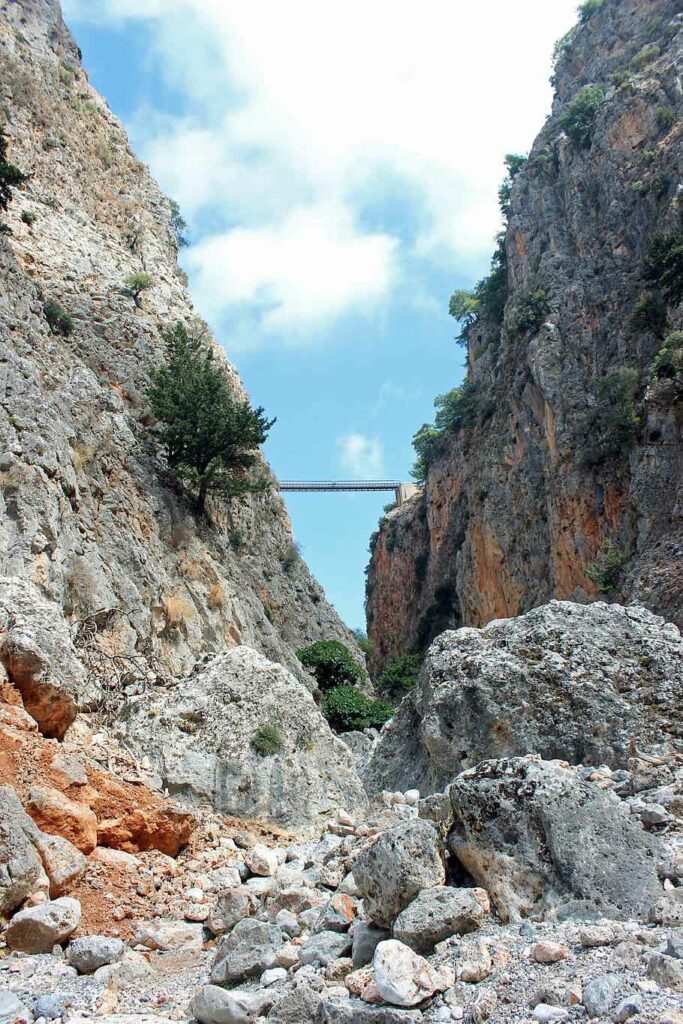
The most impressive part of the journey is from Ammoudari to
Chora Sfakion. The road, carved on the western side of the impressive
Imbrian gorge, is narrow and full of bends and U-turns. It goes
through a rough and barren landscape with steep grey rocks and
high cedar trees and offers you an amazing view of the gorge
below and the Libyan sea to the south. Although it could be
characterised as dangerous, keep in mind that it was made in
the middle of our century for travel by mule and not for vehicles,
and treat it as a sight in itself... As for the old stone parapets,
they are ideal for a short break from the journey or for a quick
picnic! So drive slowly, enjoy the view, but beware of other
vehicles too.
About two kilometres before you enter Chora Sfakion you will
see a road (A3) to your left and a GR/E sign at the crossroads
pointing you to Frangokastelo. This is where you turn if you
wish to go to Frangokastelo and Plakia (see Route 12). Close
to this crossroads you will find one of the few decent places
to stay in the entire region of Frangokastelo and Chora Sfakion,
the recently built Vritomartis Hotel and Bungalows (tel. 0825
- 091 222). Although it is far from the coast, it has a large
swimming pool and tastefully decorated areas
.
“It
was Crete’s fate
to challenge Death
and to wear on its head
the black veil...”
Old Ieronymos was born in 1913, the year that Crete regained
its freedom after seven hundred years of Venetian and Turkish
rule. The smell of gunpowder, the gunshots and the black
colour of mourning have been part of his existence as far
back as he can remember.
“Crete wears the black veil for mourning and sorrow.
Crete has always been oppressed. There were Venetians, Turks,
the Nazis...”
He did not just experience war and occupation through the
stories of his father and grandfather but lived through
them himself. In the second world war he found himself fighting
against fascist Italy on the Albanian front.
“The hunger and the cold, that’s what beat us.
For eighty days we were on the 1600 hill to the right of
Klissoura. And then that bastard officer commanded my company
to take position five kilometres further tothe north, more
snow fell, and they lost our tracks. For four days we were
stuck there, they didn’t give us anything,
they didn’t even know where we were! The fourth
day they found us and they gave us some sea biscuits.
You opened the pack and the biscuit would be full of insects.
So we wiped the insects off and ate them. They dated from
1920! But what could we do? This was all we had, this
is what we ate.
We dug a trench, threw two pieces of canvas on top to
stop the snow storm hitting us, and inside we laid a few
Italian blankets ’cause we had none of our own...
So I tried to go to sleep and there was something bumpy
under the blanket. I lift the blanket and what do I see:
the knee of a poor Italian soldier that was buried in
the snow! There must have been more than a thousand dead
bodies lying on that hill under the snow, Italians and
Greeks alike...
I left the battlefields suffering from frostbite... yes,
me, a shepherd and a hunter who’s used to the cold.
There were 160 of us in our company, but only 27 survived...
And today young people serve in the army, they have a
better time than at home and they want to commit suicide
! They are all a bunch of sissies, that's what they are
!
|
| Source of the
information on this page : “Unexplored Crete”,
Road Editions. For more guidebooks and maps of
Greece, click here.
|
 |
|