|
3. HANIA - SAMARIA (see Map
)
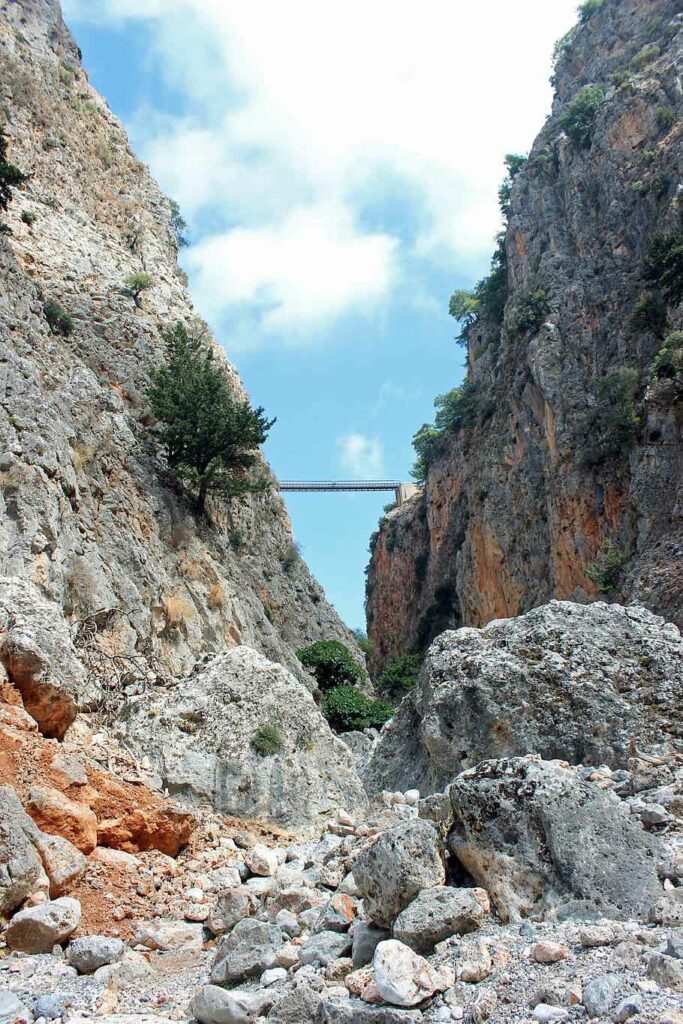
Having a total length of sixteen kilometres, this gorge is
the largest in Europe and certainly the most famous and visited
among the many gorges of Crete.
Until about the middle of the century it was a wild landscape
with a totally undisturbed ecosystem and home to a great number
of wild birds and mammals as well as to a small population of
woodcutters and shepherds who lived in Agia Roumeli or in the
village of Samaria inside the gorge.
Today this village has been abandoned, but the steep slopes
of the gorge and the thick forests in the surrounding area are
still populated with many rare species. These include over fifty
species of wild birds - among them, the extremely rare harrier
eagle (Gypaetus
barbatus) and golden eagle (Aquila
Chrysaetos), both threatened with extinction - and about ten
species of mammals among which the famous Cretan wild goat otherwise
known as
kri kri and the Cretan polecat known as zourìdha. As
for the flora of the area, it is abundantly rich and includes
many wild flowers native to this land.
In 1962, the gorge, together with a small area to the west
and east of it, was officially declared a National Park, so
that its delicate ecosystem could be protected.
The park extends over an area of 5100 hectares and, unlikeits
quiet days in the past, today it is visited by some 300,000 people
a year, all of them determined to walk the gorge. Visits are allowed
between May and October, but in July and August the tourists are
so many that it is impossible to be alone even for a minute. On
the other hand, if you can come between May and early June, or
between the middle of September and the end of October, you will
certainly enjoy it a lot more.
A good time to visit the gorge (in fact, a time before it is
officially opened to the public) is the first weekend of April,
when a two-day festival is held in Samaria in honour of Osia
Maria. The liturgy in the small Byzantine church is chanted
by father Giorgis Chiotakis of Sfakia, an amazing priest who
likes a good feast as much as anyone else and yet is a truly
holy man. This is followed by a feast featuring traditional
goodies (such as sardines and cream cheese) and some genuine
fun. If you want to spend the night in the gorge, this weekend
is your one and only chance. However, you must first contact
the Mountain Climbing Club of Hania and let them know of your
plans.
As mentioned, there are several signs of human presence in
the gorge - shaping of the entrance, fire stations, first-aid
stations, waste baskets, explanatory signs, toilets, tables
and chairs - and all these take something away from the beauty
of it. Yet the gorge still remains a landscape of unique beauty
and walking through it will be an experience to remember.
Most visitors take the early morning bus from Hania, arrive
at Xiloskalo, walk down the gorge, reach Agia Roumeli on the
other side, and then take the boat to Chora Sfakion where they
catch another bus for Hania.
This procedure has many disadvantages, especially in the high
tourist season. In the first place, you must make a very early
start; there are three to four bus departures every morning,
between the hours of 6:00 and 8:30 a.m. Second, you will get
squeezed both at the bus terminal and inside the bus, and this
will spoil your fun. Third, you will find yourself walking in
the gorge along with another hundred people. There will be someone
passing you all the time (or someone that you’ll bump
into if you walk too fast), and no matter how discreet their
presence you won’t be able to lose yourself in the landscape.
Fourth, you will be cold in Xiloskalo and hot in Agia Roumeli,
because Xiloskalo is at an altitude of 1200 metres (plus, you’ll
be there in the morning), and Agia Roumeli is at sea level (plus,
you’ll be there in the early afternoon).
Finally, you will arrive in Agia Roumeli at rush hour, and
after a tiresome and crowded journey you will have to give a
battle to secure a plate of food. And of course it will not
be the cheapest meal you can remember...
Well, guess what! We suggest you walk against
the current! Go up the gorge (instead of down), and enjoy the
many advantages of a route that’s less difficult than
you think. This will save you from many unpleasant things, among
which:
The crowded bus. In the morning, you
will start your journey from Agia Roumeli feeling the cool sea
breeze on your skin (so start early!) In the afternoon you will
be almost alone in the bus going to Hania.
The crowds in the gorge. By noon you
will practically have walked to the other side. The gorge will
be all yours, because the crowds from Xiloskalo will not have
had the time to get as far as you did.
The early afternoon heat. By that
time you will be walking the last few kilometres to Xiloskalo,
which is 1200 metres above sea level.
Still, we must warn you that during the last three kilometres
you climb 700 metres, so this last part is quite demanding and
calls for good physical condition. However, the path is pleasant,
and instead of climbing vertically it winds up the mountain
in many smooth turns.
If you are two people with two bikes you can completely avoid
the bus. The one that gets less exercise (or doesn’t care
for much) goes to Xiloskalo and walks down the gorge.
The other one goes to Chora Sfakion, takes the boat to Aghia
Roumeli, and then goes up the gorge. Then the one takes the
bike of the other and in the evening you meet at Hania. But
there is one little thing to pay attention to: When you meet
inside the gorge, do not forget to exchange keys...
Finally, if you are alone, or if everyone in the group wants
to enjoy the trip up the gorge, the best solution is to take
route 5, lock up your bikes in Chora Sfakion, and then take
the boat to Agia Roumeli and walk to Xiloskalo on the other
side of the gorge. From Xiloskalo you catch the bus to Hania
and from Hania you catch another bus to Chora Sfakion.
Here you pick up your bikes and continue your trip to the east.
|
SAMARIA GORGE: INFO AND REGULATIONS
The gorge is open to visitors from May 1 to October 31.
These dates are not fixed but can be moved forward (or...
backward) depending on weather conditions. The most important
criterion is the level of the water in the gorge, which
is particularly high in early spring (when the snow melts)
and in late
fall (when there are many sudden downpours).
It is, however, up to the guards to decide whether they
will let you in the gorge during the period that it’s
closed for the public, depending on your capacity and the
prevailing conditions.
The National Park is open daily from 6:00 a. m. to 3:30
p.m. The gorge must be crossed during those hours. It is
strictly forbidden to spend the night there.
On entering the gorge you buy a one thousand drachma ticket
with the current date on it. This ticket must be shown at
the control station on the other side. If you lose it you
must pay again, and if the date is not current they will
conclude that you have stayed overnight.
The following are strictly forbidden: swimming in the river;
cutting flowers; hunting or disturbing the animals; lighting
a fire or smoking; creating noise pollution (radios etc);
walking outside the marked path; littering the place.
Inside the gorge you will see signs informing you about
the designated rest areas, the water sources, and the location
of first-aid stations and fire stations. There are staff
members that have been trained to deal with health emergencies,
and there are mules for the transportation of patients as
well as heliports for emergency cases.
|
| Source of the
information on this page : “Unexplored Crete”,
Road Editions. For more guidebooks and maps of
Greece, click here.
|
 |
|