|
13. RETHYMNON - IERAPETRA (Following the
south coast) (see Map
1 - Map
2 - Map
3 )
Rethymnon to Agia Galini
Between Rethimno and Spili (30 km) there is a nice open stretch
of road with good asphalt (A2) that will certainly invite you
to speed. About 9 km south of Rethimno, though, slow down a
bit and look for the big Gr/E sign that says “Minoan Cemetery
of Armeni.” Turn right following the
sign, park your motorcycle next to the guard’s hut, take
along a torch and a camera with a flash, and prepare yourself
for a sight worth seeing: the most impressive Minoan cemetery
of Crete.
As you continue southward on the main road you can drive fast,
because unlike so many other roads this one has been carefully
designed. After 15 - 30 minutes (depending on how fast you go!)
you will arrive at Spili. What you see from
the main road does not do justice to this large, yet picturesque
village. If you want to see it as it really is, follow the OTE
sign and get off the main road,. take a walk through the cobbled
streets of the upper neighbourhood. (These go uphill and are
lined with aristocratic, stone-built houses that are fortunately
still lived in). On the main street you will see a small square
with seventeen lion-head fountains that
make an impressive sight.
If your walk has tired you and your stomach starts complaining,
your best option is Mr. Tzourbakis’ restaurant at the
north exit of the village. Right above it are some rooms for
rent, air-conditioned and carefully looked after.
Between Spili and Agia Galini the road is also good (A2),
with nice turns, good asphalt and clear views during the entire
route. It goes through two bald mountains with grey rock, Kedros
in the north (1780m) and Siderotas in the south (1660m). Behind
Kedros lies the Amari valley surrounded by beautiful mountain
villages,
but obviously you’re not interested or you would have
chosen Route 14! If, however, you change your mind, your last
chance to switch routes is to turn on the road (A3) that starts
a little before the north entrance of Spili. (There is a Gr/E
sign at the intersection that says “Gerakari”).
Once in Gerakari, turn to page 323 for the rest.
If you haven’t turned to page 323 it means you are a
beach lover! Sure enough, behind Siderotas you will find the
largest, cleanest, emptiest, nicest beaches in all of Crete
(Road Book 5, page 280). The coastline between Agia Irini (the
beach south of Kerames) and cape Melissa (at Agios Pavlos)
is a true paradise. After Agios Pavlos, you can find good beaches
- small, for the most part, but sandy and quiet - behind the
Asteroussia mountain range, and more specifically on the coastline
between Kali Limenes and Maridaki (the beach near Tsoutsouros).
After that, there are still some clean beaches, but the landscape
has been spoilt by the huge, plastic-covered greenhouses of
the farmers’ villages that are in the area. To reach all
these beaches you need an off-road bike, since you will be frequently
driving on quite difficult dirtroads (gravel, steep inclination
etc).
For the first beaches (the ones behind Siderotas) you need
to get off the main road at Kambos Kissou. When you get there,
turn right (in the direction of Aktounda) and follow the road
as it climbs the north side of the mountain, goes through Vatos,
Adraktos, Drimiskos and Kerames (all of which are rather indifferent
villages without much character), and takes you to the picturesque
- but almost completely deserted - Agalianos. Even before Kerames
you have a view of the coast below with its truly wonderful
beaches. After Agalianos you need to continue on a dirtroad
(D3). Road Book 5 marks the basic route to help you distinguish
the road you must take among the maze of dirtroads that end
in the olive groves. However, what will really help you is a
good sense of orientation, coupled with persistence and luck,
and the knowledge that you should never lose sight of the
coast. The first beach to the west (at the end of an asphalt-paved
road that goes south of Kerames) is Agia Irini, while the last
beach to the east that can be reached by a path branching off
the Kerames - Agia Paraskevi road (and the best beach of them
all) is Triopetra,
named after the characteristic three rocks at its east end that
jut out into the sea. Needless to say, you can camp at any beach
you like. Your water needs could very likely be covered by one
of the wells in the area, and if not, you can certainly find water
in Agia Paraskevi. Though the village has been abandoned, there
are five or six wonderful stone houses under construction, and
they will be available for renting from the summer of 1996.
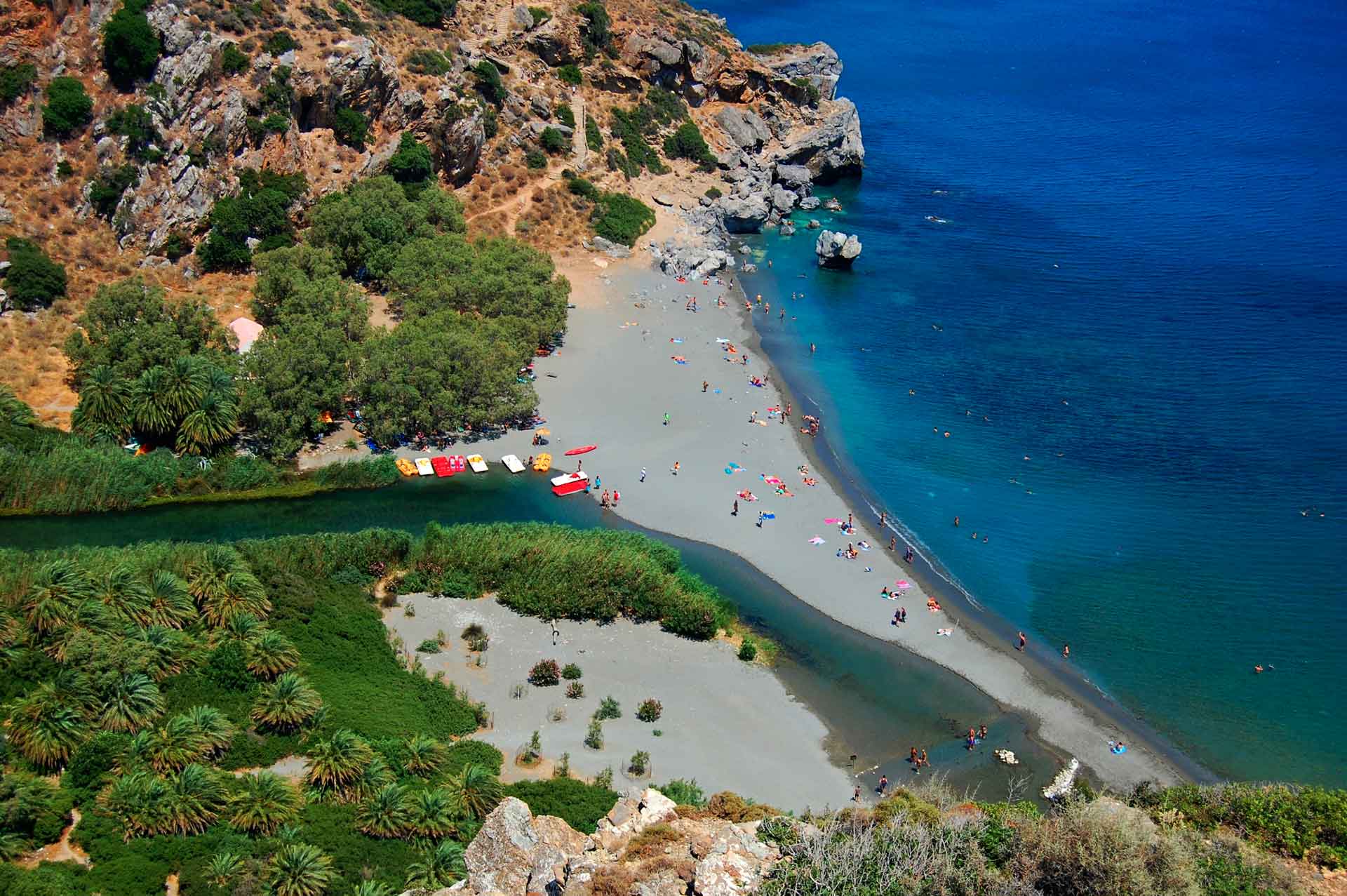
Yet the most impressive beach of Crete, a real masterpiece
of Nature, is the beach of Agios Pavlos further to the east.
This is not accessible from Agia Paraskevi, since the coastal
road connecting Agia Paraskevi and Agios Pavlos has been abandoned
and is no longer serviceable. It can be reached if you get back
on the Rethimno - Agia Galini road at Kambos Kissou, continue
southward until Nea Kria Vrissi, and then turn right. The sand
at Agios Pavlos is very rich. The beach is separated into three
coves divided by large rocks, and of these the west and middle
one are totally empty of buildings (and can be reached with
a five to ten minute walk from the top of the hill where you
will leave your bike). At the east cove you will see two or
three Rooms to Let, which are quite nice and have balconies
with gorgeous views. Their taverns are also nice, serving good
meals at low prices. Your best choice is the tavern and Rooms
to Let of Aris and Carol. Since there is no phone available,
the only way to book a room is by mail, so write early at the
following address: Carol and Aris, Taverna “To Koutali,”
Poste Restante Agia Galini, Crete.
Whatever your maps show, there is no coastal road between Agios
Pavlos and Agia Galini. The two dirtroads that seem to lead
to Agia Galini, one starting south of Sachtouria and another
intersecting the Sachtouria - Agios Pavlos road and heading
east, are in fact misleading, and they end in olive groves and
steep cliffs above the shore. To continue Route 13 and head
east again, you must first go back to Nea Kria Vrissi. From
there you can either go down the main road to Agia Galini or
take the road that takes you there through Melambes. The latter
is very slippery, though, so it is best to avoid it.
| The Minoan
Cemetery of Armeni
In the spring of 1965 a teacher at the elementary school
of Somatas saw a little fellow who was playing with a
rather unusual object. He took a closer look and to his
surprise he saw it was a Minoan vase! The kid told him
where he had found it and the teacher notified the authorities.
When the archaeologists came, the kid led them to an oak-covered
slope where his father usually took his flock.
The excavation that started immediately revealed over
three hundred graves, carved into the soft rock and dating
from the Late Minoan III period (1450 - 1100 BC). Most
of them had not been looted and gave us many treasures:
numerous vases, weapons, decorated clay coffins, jewellery
and miniature artefacts. (Some of these findings are exhibited
in the Archaeological Museum of Rethimno).
The graves were family-owned and had a square room and
a long passage carved into the rock, and a few of them
were of “royal size.”
Certainly, a cemetery as large and as well designed as
that must have belonged to a big town, but to this day
this town hasn’t been found. In spite of the many
excavations that have taken place in the surrounding area
in an effort to discover the lost town, the only findings
so far are a stone-paved street near Kastelos and an ancient
copper mine four kilometres to the west of it. Even the
largest and most renowned cities can desapear fromthe
face of the earth, and under the weight of the centuries
their names and easily forgotten...
|
| Source
of the information on this page : “Unexplored
Crete”, Road Editions. For more
guidebooks and maps of Greece, click here.
|
 |
|