|
12. HORA SFAKION - RETHYMNON (see Map
)
(Following the coast)
About two kilometres east of Chora Sfakion you will see a road
(A3/25km) that leads to Frangokastelo. It is a narrow road with
many turns and potholes, carved on mountain slopes full of olive
groves and following the coastline from a certain distance.
Though it doesn’t climb too high, it allows a wonderful
view: to the south you can see the Libyan sea,
and to the north a succession of high mountain peaks (all over
1000m), which are often separated by deep gorges.
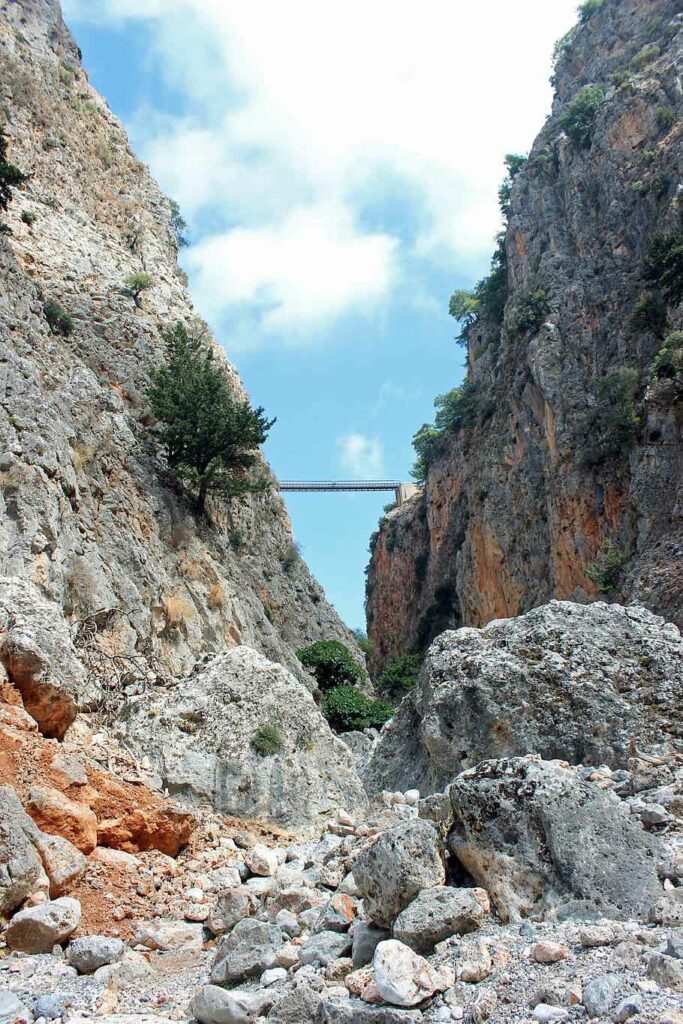
Three of those gorges are very good for walking. If the length
of the Samaria gorge or the crowds visiting it have discouraged
you from walking through a gorge, this is your chance to change
your mind. All three gorges are quite as beautiful, and yet
much smaller, quieter, and easier to cross. The first, the Imbriotiko
gorge, is 3 km long, and the path for climbing it starts
from Komitades and ends in Imbros (total route length: 4 km).
The second, the Agios Nektarios gorge, is 2
km long, and the path for climbing it starts from Agios Nektarios
and ends in Asfendou (total route length: 3.5 km). The third,
the Kallikratiano gorge, is 1 km long, and
the path for climbing it starts from Patsianos and ends in Kallikratis
(total route length: 4 km).
As mentioned, all three gorges are quite small, so you can
start early in the morning and walk through them without great
effort. In the process you will also enjoy the gradual change
of scenery as you move from the sea to the desolate Sfakia countryside
with its typically poor villages. No matter how slow your pace,
you will certainly have enough time to rest, to walk leisurely
back - you should be at your base no later than early afternoon
- and to cool off with a good swim.
Certainly, you can lock up your bike at the village from where
your hike begins and go as far as your strength and desire takes
you. But if you can do it, we think it is worth walking to the
village at the other end of the gorge. Imbros, Asfendou and
Kallikratis are all very picturesque with their traditional
stone-built houses, and if you do not visit them by following
Route 11 you ought at least to hike there on a break from Route
12.
As you drive on the main coastal road, you will see many dirtroads
- or even asphalt ones - branching off toward the sandy beaches
to your right. The first one on your way is the large sandy
beach in front of the famous Frangokastelo.
Next to Frangokastelo one can see the abandoned monastery of
Agios Haralambos. Unfortunately, only its church has survived,
while all the other buildings have fallen apart. Just east of
the monastery lies a beautiful beach with big sandhills.
|
Frangokastelo
Frangokastelo is
just one more fort that testifies to the Venetians’
vain desire to impose their rule even in those parts of
the island where they had nothing to gain. It was built
in 1370, thanks to the insistence of the feudal lords
of Rethimno, but it was never used, at least not by the
Venetians! The locals paid no attention to this isolated
and harmless fort, and they kept on living unsubdued...
taking their rebellions just a little bit further. The
decline of its glory started from its very first day.
The Venetians grew tired of sitting around in a remote
fort doing nothing, the garrison was reduced to very few
men, and the guards napped on their posts, lulled to sleep
by the waves and by the sound of the bells of the local
shepherds’ goats. How can you play the part of the
defender of a place if no one is willing to attack you?
The cannons soon grew rusty from disuse, and the fort,
gradually abandoned, started falling apart.
It took another 450 years before there was some action
to justify the fort’s existence. We are speaking
of the amazing Frangokastelo battle (1828), which took
place between the Turkish army, led by Moustafa Pasha,
and a Greek army force from Ipiros, led by Hatzimichalis
Dalianis. Now, what business did an army force from Ipiros
have on the island of Crete is quite a long story.
But to make it short, let us simply say that those designing
the tactics of the Greek War of Independence (which broke
out in 1821 and ended with the liberation of Roumeli and
the Peloponnese) felt that the Cretans lacked in tactics
and performance and were in need of support. Yet the Cretans
knew very well what they were doing. They took advantage
of their inaccessible mountain peaks and deep gorges and
fought a war of quick assaults and safe retreats in their
hide-outs. Still, the generals from the Greek mainland
felt that killing ten to fifteen Turks each time was not
the best way to eliminate the Sultan’s countless
Turkish, Albanian and Egyptian soldiers. As a result they
sent an army force of 600 infantrymen and 70 horsemen,
led by Hatzimichalis Dalianis, to free Crete with large
scale, face-to-face battles. Moustafa Pasha rushed out
to meet them, starting with a... moderate 8000 and 400
men respectively. As you may guess, Dalianis and his troops
did not live to give many battles...
The Cretans advised Dalianis to follow their own tactics,
but he did not listen to them. He called them “cowards”
and proceeded to do things his own way. Ignoring the insult,
the Cretans wished the brave Ipirian leader “good
luck” and retreated to their mountains. Dalianis,
on the other hand, ranged his men in the valley in front
of Frangokastelo and waited for the Turks to show up.
When they did, a fierce battle started, which resulted
in twice as many deaths on the part of the Turks. After
an hour or so, 200 Greeks had been killed -their leader
included - compared to 400 Turks. If things went on like
that, the remaining 400 Greeks did not have much future
in the fight against the 8000 Turks opposite them. They
wised up at the last moment, saw an empty fort behind
them, and quickly barricaded themselves in it.
And so it happened that for the first time in 450 years
the fort fulfilled its purpose! And in spite of being
abandoned it did its job very well! The besieged managed
to keep the Turks away for seven days. By that time, Moustafa
Pasha had begun to feel threatened by the quiet reinforcements
he saw gathering up around him, and he chose to withdraw
his men discreetly. As a gesture of good will, he allowed
the exhausted warriors to leave the fort, promising he
would not harm them. Then he tore down a big part of it
and started retreating toward the northeast. But the Sphakians
who had come to the aid of Dalianis waited for him at
the gorges. They were not used to gestures of good will
(and why should they be?) so they viciously attacked him
and destroyed his army.
If you want to get an idea of the terrible condition in
which the besieged soldiers were when they left the fort,
come here on June 4, 5, or 6 at the crack of dawn. You
will see the Drossoulites, the sad ghosts that each year
appear before the walls, floating about gloomily. This
vision or mirage has not yet been explained, and it is
certainly very interesting.
Frangokastelo survives in very good condition, thanks
to the last repairs made by the Turks in 1866. Above the
gate one can will see a somewhat worn stone, on which
are carned the Lion of St. Marcus and tow coats of arms
belonging to Venetian feudal lords.
|
Although the area around Frangokastelo has just begun to be
developed, most hotels and Rooms to Let are ugly, because they
were designed and built quickly and without any aesthetic concerns.
The only exception is the guest house at Patsianos, which was
built very recently and doesn’t have a phone yet. If you’d
like to camp, the beach of Frangokastelo is all yours, and the
taverns all around will help to cover your needs.
The next attractive beach as you go east is the sandy Korakas
Beach. This can be reached by the dirtroad (D3) that you will
see a few kilometres after Frangokastelo or by an asphalt road
(A3) that passes through Rodakino. Needless to say, it, too,
is surrounded by several small hotels, Rooms To Let, taverns
and restaurants.
When you reach Selia you will see a dirtroad (D2) that goes
south. A little before it reaches the shore another road branches
off to the west and takes you to Souda, a wide beach with palm
trees.
If you continue eastward on the coastal road, you will soon
be at Plakias.
This was a tiny seaside settlement, built around the turn of
the century
by a few fishermen from the nearby Sellia. Until 1970 it had
no more than ten permanent residents, but today it has about
twenty hotels, five hundred rooms that are rented out to tourists,
and many restaurants, bars and discos that serve the needs of
the huge crowds that arrive here every year (and we are talking
about five-digit numbers). The main attraction is the large
sandy beach of the village, but unfortunately this is usually
covered with rented umbrellas and deck chairs. (However, you
will find a few quiet and clean corners at the west and east
end of it). If you absolutely must stay here, your best choice
is the Plakias Bay Bungalows, a well looked after complex at
the east end of the beach, away from the noise of this cosmopolitan
resort. (If you are hungry, by the way, there are plenty of
taverns on the main road of the village, but we recommend Sunset,
the fish-tavern at the west end. Despite its banal name, it
serves fresh fish that are very well done as well as many other
tasty dishes). An alternative to the bungalows type of accommodation
is the Plakias camping. It is a big site at the village entrance
that should give you plenty of space, but the truth is you must
look hard for a quiet spot to settle. For true camping, away
from the tourist crowds, head east of the village, in the direction
of Lefkogia.
The road (A3) is intersected by a second road that leads to
the Damnoni beach (which was very beautiful once but has now
been spoilt by the sight of a huge, rich-people’s bungalows
complex that was built here by a Swiss company). Pass the intersection,
and a little before Lefkogia turn right on the road (A3) where
you will see a sign that says “HOTEL RESTAURANT AMMOUDI.”
This road ends at a wonderful sandy beach, full of shade-giving
trees, a secluded place that is ideal for camping. About two
hundred metres to the back is the very good “Ammoudi Hotel
& Restaurant”, a small and elegant building that belongs
to the Daskalakis family. Other than that, the beach is empty
of buildings, and it still has great natural beauty (but for
how long?) It is ideal for relaxing - though you can always
visit Plakias when you want to see some action - and it is also
a great base for small trips in the area. The Amari valley in
the east and the Sphakia region in the west are among the places
to visit.
After Lefkogia you will see a road (A3) to your right, which
goes to a hamlet called Gianniou. Turn on this road and follow
it to the village. From here on you continue on a dirtroad (D3),
which takes you to a pass between two hills. Right after the
pass you get a view of the Libyan sea and soon afterwards the
Preveli monastery (Moni Preveli) appears before your eyes. To
be precise, this is the Pisso Moni Preveli, to be distinguished
from the Kato Moni Preveli that is close by.
| Moni Preveli
Pisso Moni Preveli
It is not certain when exactly and by whom the monastery
was founded .
The countless raids, the looting, and the destruction
it so often suffered - like all Cretan monasteries - resulted
in the loss of precious historical documents that could
shed light on its past. Carved on the monastery fountain
is the year 1701. Yet the church bell of the “twin”
monastery Kato Moni Preveli, a couple of kilometres to
the north, suggests a different time of foundation, since
the inscription on it reads “1594.” The monastery
was built at a secluded place with an excellent view of
the Libyan sea (as
you can see for yourself), but the serenity of the landscape
around it sharply contrasted with its -
mostly - turbulent history. Like most monasteries in
Crete (or Greece, for that matter), it frequently served
as a refuge for rebels or even as their base of operations.
During the second world war it offered protection to the
allies; it was here that they found refuge, and it was
from here that their departure from the island was organised.
Today, the monastery’s small but well organised
museum contains many interesting exhibits, precious relics
that the monks were able to save from destruction. Among
them is a silver-plated cross, which, as the story has
it, is made of wood from the Holy Cross and has the power
to work miracles.
The buildings you see at the monastery are not the original
ones. Those were destroyed, rebuilt or modified so many
times that nothing is left from them. The church was built
in 1835. It has a beautifully carved wooden icon screen
with wonderful icons, some of which come from the church
before it. Especially noteworthy are the icons of Christ
the High Priest and of Adam and Eve in Paradise, at the
left door-leaf and the lower right corner of the icon
screen respectively. The latter catches the eye with its
great variety of birds, fish and animals painted in bright
colours, and both are works of Michail Prevelis and date
from 1750. The works of this monk as well as the other
treasures of the monastery and its exciting history are
a good reason for visiting the place. And if you go in
early spring or late fall, when there are not so many
visitors around, Father Kallinikos and Father Chryssanthos,
the two monks that live there, will be glad to show you
around. Incidentally, Father Chryssanthos speaks very
good English.
Kato Moni Preveli
This monastery is in a terrible condition, and little
by little it falls apart. The cells still have walls,
but they have no roofs. The church, which is dedicated
to Jonh the Baptist, has a roof, but it has suffered great
damages and it was both abandoned and vandalised. Yet
the fountain at the entrance can still quench your thirst.
|
About 500 metres north of the abandoned Kato Moni Preveli is
a road (D3) that goes east. At the intersection you will see
a misleading E sign that says “Palm Beach 2 km,”
but points you in the same direction you came from. Ignore the
sign and turn right (east). You will pass a brook with a small
bridge, and after 6 km you will be at the coast, at a small
parking area next to a couple of taverns. Leave your bike in
front of whichever tavern you like best so that the tavern owner
can keep an eye on it - needless to say, you’ll promise
him that you will eat there after your swim - and continue on
foot (Palm Beach is only ten minutes away).
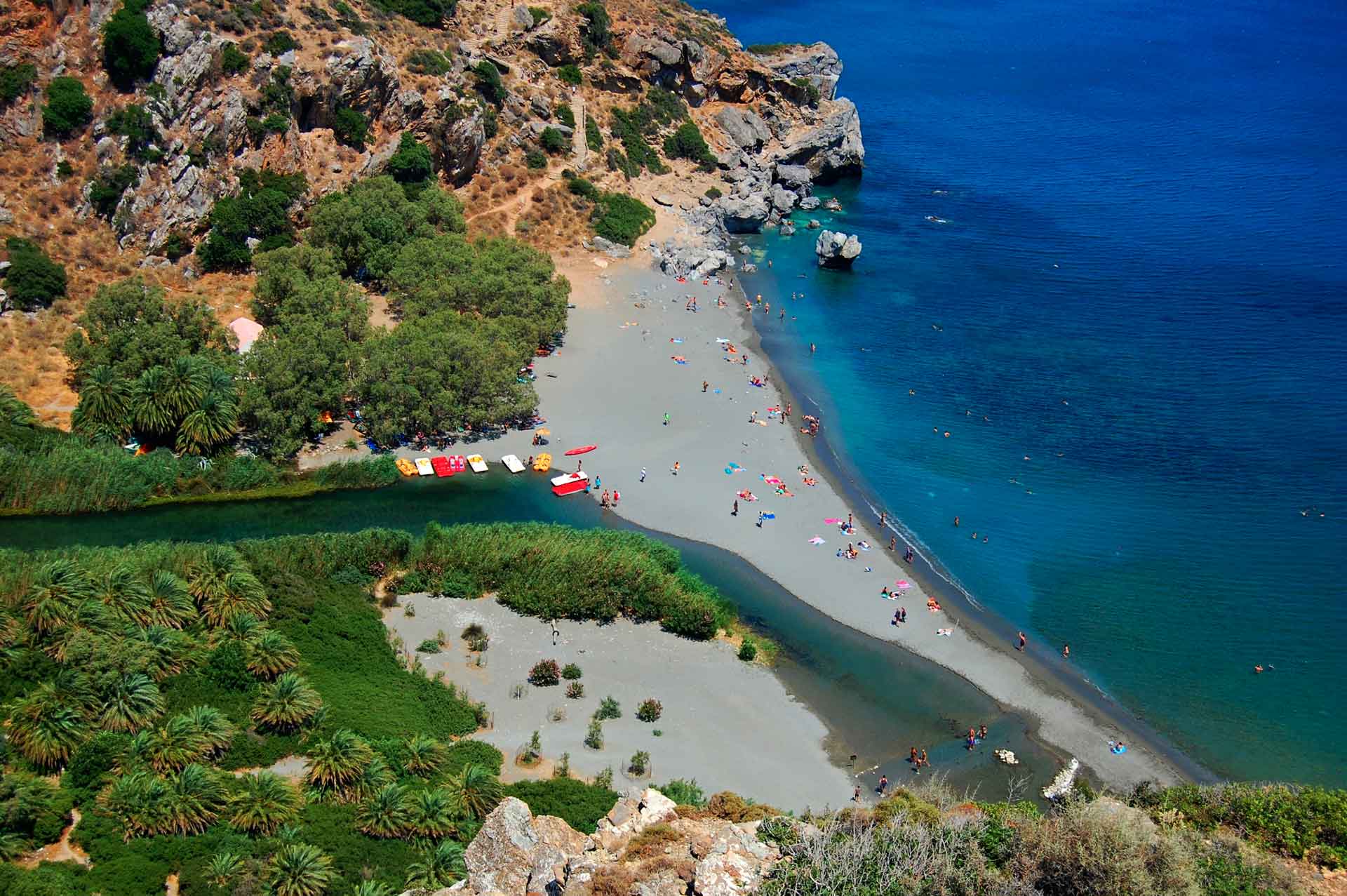
The sight you will see is indeed beautiful: lots of palm trees
growing alongside a river that divides the beach into two parts
and flows into the sea. Yet the famous beach attracts
too many visitors and campers, and especially in the high season
it is extremely crowded and filthy.
If you are looking for empty beaches with crystal-clear water,
take the dirtroad (D3) that you’ll see about two or three
hundred metres before the taverns. This goes east and takes
you to the road (A3) that connects Kerames and the Aghia Irini
beach in the south. The beaches between Aghia Irini and Aghios
Pavlos in the east are the best of Crete (see Route 13 and Road
Book 5).
If you get back to the route and follow the road (A3) north
of the abandoned Kato Moni Preveli, it will take you to Assomatos.
After the village the road continues through the impressive
Kourtaliotiko gorge with the high steep walls. At the north
end of the gorge there is an intersection. If you want to complete
Route 12 and to get to Rethimno, continue straight (in the direction
of Koxare). After a while, you will hit the main road (A2) that
connects Aghia Galini with Rethimno, and from there it’s
only a matter of fifteen to twenty minutes till you reach the
town.
If, however, you have no desire to go to Rethimno, turn right
(east) and follow the road to the picturesque Frati. If you
keep going east, the road (A3) will take you to Aghia Pelagia
and then to Mixorrouma, and from here you can either continue
eastward, following Route 13, or cross the main road and continue
toward Karines in the north (from where you can follow Route
14). A third option, for those that have off-road bikes and
enjoy beautiful scenery, is to follow the dirtroad (D2) that
starts at the east exit of Frati and takes you to Mourne. You
will pass through a wooded area with plenty of chapels and places
suitable for camping, then get to the village and continue on
the asphalt-paved road that leads to Spili. Here you have again
two options: continuing south towards Aghia Galini (see Route
13), or taking the dirtroad (D3) northeast of Spili in order
to get to Patsos and take Route 14.
| Source
of the information on this page : “Unexplored
Crete”, Road Editions. For more
guidebooks and maps of Greece, click here.
|
 |
|