|
10. KISSAMOS - SIRIKARI (see Map
)
In the town of Kissamos (Kasteli) you will see an intersection
with a Gr/E sign directing you to Polirrinia. The road (A3)
goes south, climbing some small hills full of olive groves and
vineyards. Drive carefully because there are many potholes and
dangerous turns. The problem with the potholes gets even worse
after the village of Grigoriana.
It gets so bad that the road has... more potholes than asphalt,
but luckily this doesn’t last long. The asphalt ends at
the centre of Polirrinia, where you will see a restaurant and
some Rooms To Let; just north of the village is a hill (417m
high) with the ruins of the ancient town. The
foot of this hill can be reached in two ways: you can walk through
the cobbled streets of the village, or you can turn left on
the dirtroad that you’ll see about a hundred metres after
the sign at the village entrance. This road will take you to
a cemetery, where you can leave your bike and continue on foot.
At the cemetery you will see the church of the Holy Fathers,
which is partly constructed with ancient building materials.
The ancient town of Polirrinia
Two cocks in the same hencoop are bound to fight, and two
powerful towns in the same area cannot be the best of neighbours.
Ever since the Achaeans settled in this area in the 8th century
BC and built the town of Polirrinia on a tall, well fortified
hill, they were in constant fight with their more powerful neighbours,
the Kidonians, who had settled just a few kilometres east of
the town, on the site of modern Hania. Judging from the name
of the town (Polirrinia < Gr. poly, many and ren[e]a, sheep),
one would think that the settlers were peaceful shepherds. In
reality, they were a warlike people that survived mainly for
being good warriors. Many of the town’s coins depict Athena
as a warrior-goddess, wearing a helmet and bearing a spear in
her hand.
Athena and Artemis, it seems, were the two patron goddesses
of the town, and apparently they did a good job at protecting
it since during the entire classical and hellenistic period
the town and its two seaports, Falassarna and Kissamos, managed
to survive without any major war catastrophes. When the Romans
appeared on the scene, the Polirrinians quickly entered into
an alliance with them - before the Kidonians could do the same
- and with a sweeping attack they managed to teach their age-long
enemies a good lesson. All during the period of the Roman rule,
Polirrinia was a prosperous town, well protected behind its
high walls.
After the 3rd century AD we have no reference to it, but in
the 10th century it is once again mentioned in the literature,
this time as an important Byzantine town. Today one can see
the ruins of the city wall, which belong mainly to the Byzantine
period, as well as a couple of aqueducts from the Roman times,
carved into the rock and preserved in very good condition. From
the earlier periods of the town’s history only few things
have survived, such as the foundations of some temples and houses
and a number of inscriptions. Also,
close to the two aqueducts above the town is a small cave dedicated
to the Nymphs, in whose walls one can still see the carved niches
that contained the Nymphs’ statuettes. If you are wondering
what happened to the hundreds of stone-built houses and the
temples and big public buildings of the town, you should know
that they didn’t disappear, but they simply changed form;
the modern village of Polirrinia has inherited not only the
name of the town, but also all building materials that were
still of use. Recycling, one could say, in its purest form!
About 150 metres before the sign with the village name you
will see a dirtroad (D3) to your right with a small sign marking
the European Path (E4). Turn right on this dirtroad, and after
400 metres you will see a building with a tiled roof, which
houses the elementary school of the village.
Turn right and follow the E4 diamond-shaped signs: make a right
turn 50 metres past the school and a second right turn after another
100 metres, and at the next two or three intersections that you’ll
see keep turning right. The road goes through a desolate landscape
with low hills covered with bushes, passes through the small village
of Galouvas, and takes you to Loussakies where it meets the main
road. Go left at this point and continue until you get to Zachariana.
About 300 metres after the sign west of the village, turn left
on the dirtroad (D3) which you will see climbing the mountain
- there is an E4 sign at the intersection - and reset your counter
in order to follow Road Book 2. Until the village of Sineniana,
you will be travelling through a rocky area with many chestnut
and olive trees, while at some point you will cross a small plateau
where you could pitch camp. (This lies about 550 metres above
sea level). After Sineniana the scenery becomes immensely enjoyable
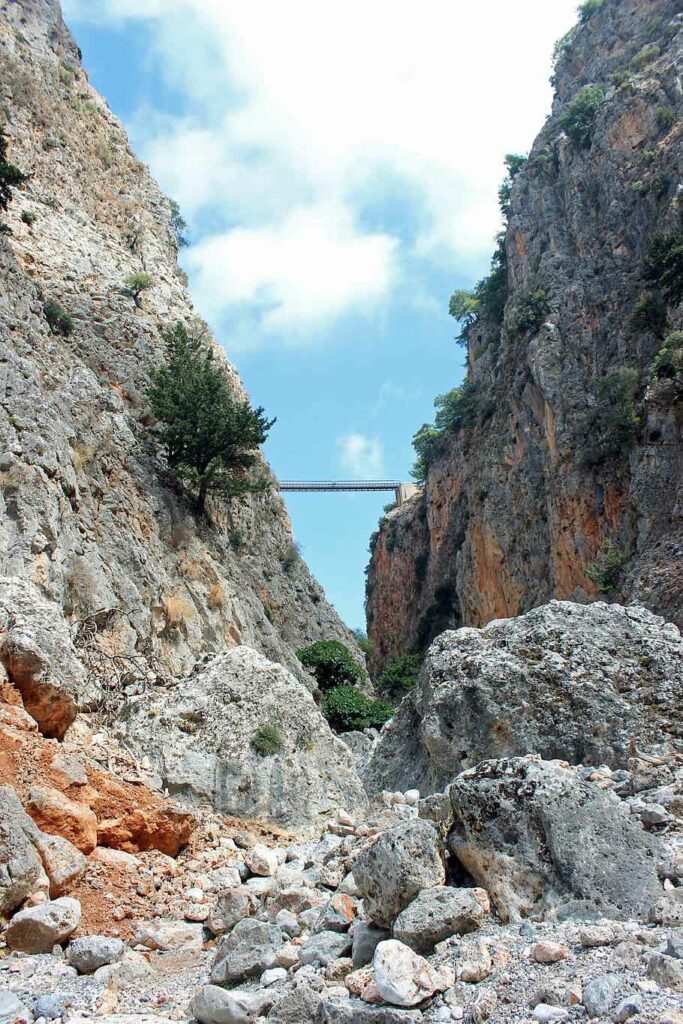
and you pass through a gorge full of plane, chestnut and oak trees
that has some very inviting spots for camping right next to the
river. At about 1.5 km after the village you will see a dirtroad
(D2) to your left, which leaves the gorge and joins the asphalt
road just a few metres north of Sirikari. After Sirikari, the
road (A3) goes downhill through the olive groves, and all you
have to do is follow the signs that will take you back to Kasteli.
If you do not want to return to Kasteli, you have two options.
One, you can turn right at Kalathenes so that you get to follow
Route 8. Two, you can simply ignore the road that goes to Sirikari
and keep going straight. A few kilometres down the road you
will see a chapel followed by a dirtroad on your left-hand side.
This dirtroad leads to the picturesque Kostogiannides, but we
suggest you ignore it and go straight. If the night is falling
and you are tempted by the idea of camping in the area, there
is an excellent spot by the river, where you can camp in the
shade of huge plane and chestnut trees. (Just turn on the dirtroad
that you’ll see to your right about a hundred metres after
the chapel and you will find it). When you get back to the route,
follow the dirtroad as it turns to the west and climbs the mountain.
You will travel through a very beautiful forest of giant chestnut
trees and then through a pass at an altitude of eight hundred
metres. This is the highest point of the route, and it offers
a spectacular view of the west coast of Crete, especially at
sunset. From here on the road winds down the mountain through
the woods and takes you to the village of Kambos from where
you can follow Route 7 to Elafonissi.
| Source of the
information on this page : “Unexplored Crete”,
Road Editions. For more guidebooks and maps of
Greece, click here.
|
 |
|