| |
| Travel &
holidays in Greece, Athens, Crete, Rhodes, accommodation, car
rental |
| Individual
holidays to suit your personal needs |
|
|
.Region
of Chania (western Crete) |
Virtual
tour of Crete. Place
the cursor on...
 |
|
|
Askifou.
The village of Askifou is located on a magnificent plateau, 700 m above
sea level, and is worth a quick visit on your way to Sfakia (Chora Sfakion).
Be sure to taste the local specialty "sfakiani pita", a turnover stuffed with
ewe cheese or "mizithra".
Kournas
(Lake). Crete has only a few, small lakes. Lake Kournas is the largest, and
its position in a landscape full of contrasts gives it a certain charm.
Therissos.
17 km from Chania. The road runs through a gorge, along
a river lined with plane trees. This village is well-known for the battles fought
by the Cretans against the Turkish occupying forces during the 19th century,
but it is also associated with a key Greek politician of Cretan origin, Eleftherios
Venizelos, (the equivalent to Churchill for Britain or De Gaulle for France),
who was Prime Minister of Greece on several occasions from 1910 to 1932. He
had set up his headquarters in this village at the beginning of last century,
during his struggle for the incorporation of Crete into Greece, which was finally
achieved in 1913. Do visit the little museum, where a number of interesting
original documents are displayed. For nature lovers and hiking enthusiasts,
we suggest two excursions: One that leads to Drakona, Plativolia, Thima and
Kambi, and the other to Zourva (a 1-1 ½ hour walk).
Aradena.
A prosperous village during the Venetian period (1204-1669)
and at the beginning of the Turkish occupation (1645-1898), due to trade and
arms manufacturing, but completely destroyed by the Turks on several occasions
owing to the constant resistance of its inhabitants. The village had probably
been built by the inhabitants of Phoenix, a tiny port on the coast, as a shelter
against pirate attacks. The hike to Aradena is one of the best in Crete. The
village has been abandoned since the 1960s because of a vendetta, but you can
still find a few beautiful houses with arches (kamarospita), the impressive
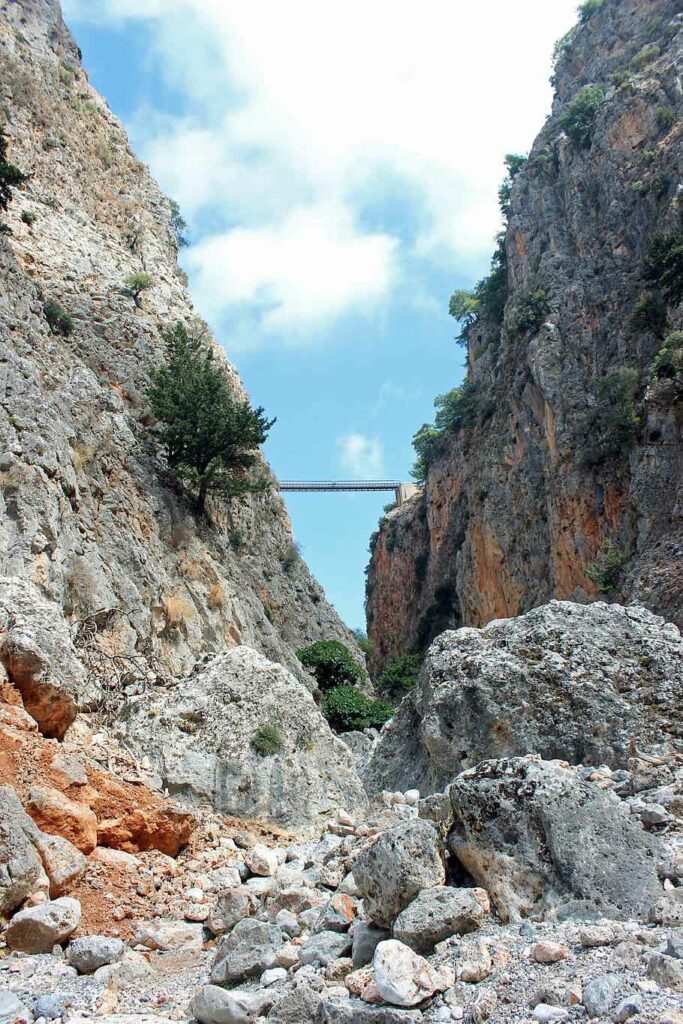
"American bridge" which joins both sides of the gorge (over 100m deep), and
the pretty church of Michaïl Archangelos (Michael the Archangel), built on the
foundations of an early Christian basilica, in the form of a cross.
Anopoli.
This village, in the middle of nowhere, was built on the
location of an ancient Minoan site bearing the same name. The 12 km-long, winding
road which leads to Sfakia offers absolutely fabulous views, especially in the
morning. The Anopoli plateau is inhabited by proud and hospitable mountain people,
who grow wine, olive trees, and various vegetables. Rooms can be rented here.
Loutro.
A rare natural site, this charming and peaceful, "car-free"
village, is accessible only by foot from Aradena or Sfakia (for the adventurous),
or by the ferry that makes the hourly journey between Paleochora, Sougia, Agia
Roumeli, Loutro and Sfakia. Many typical tavernas, and rooms to let. For the
loners and the hiking enthusiasts, Loutro is an absolute dream!
Sfakia
ou Chora Sfakion.
Famous for its battles against the occupying forces, in
particular Turkish and German. Once a prosperous port whose main activities
were trade and piracy, Sfakia now lives strictly off tourism. Its tiny harbour
is an essential stopping place for the boats carrying the numerous hikers who,
having just completed their trek through the gorge of Samaria, disembark here
to take their buses back to their point of departure. Sfakia is also a starting
point for a number of hikes, such as those leading to Anopoli and Aradena, or
Loutro. It's charm, ambience and the amenities available also make it a nice
place to stay, and its strategic location allows for boat trips to the other
little ports along the southern coast.
Frangokastello.
("Frankish castle"). This impressive, well-preserved
fortress was built by the Venetians in 1371. It was often used as a shelter
against the numerous pirates who would overrun the region, due to its strategic
location at the "crossroads" of the eastern Mediterranean. The castle's majestic
position just above a pink sandy beach adds a certain charm to the latter. Frangokastello
is the starting point for quite a few hiking trips and excursions.
Imbros.
(Gorge) Starting point for an 8km-long hike through the
pretty Imbros gorge along the river bed. Not a difficult hike, in spite of the
sharp descent. You'll need about 3 hours, and good hiking shoes. The gorge ends
in the village of Komitades, where you can stop for refreshments. Sfakia (Chora
Sfakion) is another hour's walk, and from there you can take the bus back to
Chania or the ferry to one of the ports on the southern coast (Timetables available
in our site).
Sougia.
A little fishing village twenty years ago, Sougia, with
its 1km-long beach, seafront tavernas under tamarisk trees and nudist beach,
is now a popular spot, especially for young people. A very pleasant hike from
Agia Irini leads to Sougia.
Agia
Irini.
From this long, narrow village you can start a nice hike
through the gorge which leads to Sougia. This mountain village often suffered
from vendettas in which whole families were killed. Be sure to stop off at the
village kafenion and taste the local drink, a sort of schnapps made with mulberries.
Souda.(Bay).
A vast natural harbour close to Chania. Daily sea links
with Pireus (the port of Athens).
Akrotiri
Peninsula. When leaving Chania, take the road leading to the airport.
This peninsula is characterized by an interesting and varying relief : flat
inland, in contrast with a coast of arid mountains with cliffs and beautiful
beaches (Kalathas and Stavros in the north, Sternes and Marathi in the south).
Stavros is where the spectacular scene of the cableway collapse was shot for
the film “Zorba the Greek” featuring Anthony Quinn, based on the
novel by Nikos Kazantzakis. For the culture and history enthusiasts, there are
two beautiful monasteries to be visited: the elegant monastery of Agia Triada
(about 10 km south-east of Stavros), and Moni Gouverneto, which looks like a
fortress on the outside, but is actually quite warm once you enter the courtyard
planted with lemon and orange trees and, most of all, covered with flowers.
If you’re wearing appropriate shoes, you can walk down to the sea (half
an hour on foot), and on your way down you can visit two caves, one of which
is about 100m deep.
Samaria
(gorge). The classic Cretan hike 'par excellence', now
slightly over-frequented, but almost a "must do" once you visit Crete. It is
one of the longest gorges in Europe (16 km), and in the opinion of the Cretan-born
writer of these lines, they are the most beautiful. A 3 to 8 hours' walk, depending
on whether you choose your own pace, or are obliged to follow the group. Accessible
to everyone, provided that one is in good physical condition and footsure. Following
the river bed, the gorge ends at Agia Roumeli, a small friendly coastal village
with bars and restaurants on the seafront and a beautiful sandy beach. An unforgettable
experience.
Omalos
(plateau) Your arrival here is the first phase of the hike through the Samaria
gorge. If you decide to use a Cretan travel agency, for a reasonable fee you
will be taken by bus very early in the morning to the point of departure (Omalos-Xiloskalo),
and the bus will collect you at the end of the afternoon in Sfakia (Chora Sfakion).
So you start your hike through the Samaria gorge in the morning, and you arrive
in Agia Roumeli at about 2 or 3pm, where you can have lunch and a sea-bath before
taking the ferry to Sfakia where the bus will be waiting to take you back to
Chania (about 6 pm). If you’re not too keen on group excursions, you can
take the first bus from Chania to Omalos at about 6 am. You hike through the
gorge, and you arrive in Agia Roumeli. Since this village has no road links
with the rest of the island, you will need to take the ferry to Sougia, Paleochora
or Sfakia, and take the bus back to Chania from there. (For bus and ferry timetables,
see the relevant page of our website). Another possibility: go to Omalos early
in the afternoon, at about 1 pm, and do the trek through the gorge undisturbed
after the groups have all descended. The gorge will be all yours! You will reach
Agia Roumeli early in the evening, where you can take a dip, have dinner, and
rent a room for the night. Even during the month of August, you will have no
trouble finding a room. The following day you take the ferry back to Chania.
It is up to you…
Balos
(bay) A lagoon in the middle of nowhere, and yet, in the heart of the Mediterranean,
on a peninsula still virtually untouched. To get there you can either take the
boat from Kissamos (daily departure at 9 am and return at the end of the afternoon),
or drive there in a 4x4 jeep. You can also go to Balos on foot, by following
the well-indicated footpath which starts at Kaliviani. Take along refreshments
and water, and start your hike at daybreak, for the 9 km-long path is entirely
exposed to the sun. Upon arrival, you will be rewarded by a fine, pink sandy
beach and a turquoise sea. One of the most beautiful beaches in Crete. You can
then discover another site of interest on the islet of Imeri Gramvoussa: a magnificent
Venetian fortress, built in 1579, occupied by the Turks, and then used by the
pirates as a secret den, their water tanks still visible. The Cretan writer
Kazantzakis, in his “Report to Greco”, relates how his Saracen great-grandfather,
with his “skull shaved in the front and with a long plait to the back”,
would board the vessels carrying groups of pilgrims towards Mecca or Jerusalem,
and would indiscriminately slaughter both. Once, he even captured a schooner
full of spices, and not knowing what to do with it, he decided to have it distributed
in all the villages of Crete. And then the whole island became fragrant…
Falassarna.
A magnificent beach in an ancient, extraordinary, site. The rapid development
of tourism in this area over the last few years has brought about the inevitable
(and sometimes not-too-positive) changes.
Hrissoskalitissa.
(Monastery). Built on a solitary rock overlooking the sea, this impressive monastery
was erected during the Venetian period and dedicated to the Holy Virgin. Each
year on the 15th of August, thousands of pilgrims flock to the site to kiss
her icon. According to the legend, the 90 steps which lead up to the monastery
are made of gold, but only pious believers, free from all sin, can see them.
Hence the name Chrissoskalitissa, which means “the golden stairs”.
Elafonissi.
Still one of the most beautiful sites, in spite of the flood of tourists who,
having discovered it about twenty years ago, arrive in large numbers during
the months of July and August. The best times to go are in the morning and late
in the afternoon. A long beach of fine pink sand, a blue-green sea, and a little
island which you can reach by simply walking through the shallow water.
Kandanos.
The head of the Greek Orthodox church was based in this village during the Byzantine
era, as was the Roman Catholic bishop during the Venetian period, which gave
the province its artistic and architectural wealth. Kandanos was razed during
the German occupation and its inhabitants shot down, in retaliation for a deadly
attack made by the Cretan partisans. Visit the memorial which was erected in
the village square by the occupying forces of that period, and be sure to read
the inscription on the stele…
Paléochora.
A small town with lots of visitors in summer, but still quite pleasant. With
one harbour and two bays, it is one of the prettiest sites in Crete, although
the strong influx of July and August tourists makes it a bit overcrowded. The
large number of coves in the area, the interesting excursions that can be made,
and a pretty natural landscape, make Paleochora very attractive to vacationers.
Sea links every hour with Sougia, Agia Roumeli, Loutro and Sfakia.
Agia
Roumeli.
A little village situated at the exit of the Samaria gorge,
accessible only by the ferries which serve the southern ports of the region
(Paleochora-Sougia-Agia Roumeli-Loutro-Sfakia). The rooms to rent, tavernas,
bars, not to mention the beach, are a welcome reward for many a tired hiker
after an energetic trek through the Samaria gorge. Should you stay overnight
in Agia Roumeli, you can get up early in the morning and visit the Turkish fortress
towering above the village (a one hour walk). The view is exceptional.
Kalamaki,
Agia Marina, Platanias...When
leaving Chania on the coastal road leading west in direction of Kissamos, you
will pass through villages, which, in summer time, are transformed into very
busy tourist sites. Plenty of shops, hotels, rooms to rent, restaurants and
other amenities. Very lively at night. For those seeking an area with lots of
activity.
Kolimbari.
This village has kept its typical rural atmosphere, despite the appearance of
tourism, albeit limited in scale. Typical tavernas built along the shingle beach,
a magnificent view of the bay and the peninsula, and a bottle of good Cretan
wine will be sufficient incentives for you to want time to stand still. About
a hundred metres north of the village, visit Moni Gonia, a monastery built in
the 17th century, with a long history of resistance against the Turkish and
German occupying forces, and featuring 14th century icons, a small museum and
beautiful Venetian-style architecture.
Kissamos
(Kastelli). Harbour of the ancient city of Polyrinia. Nowadays it is a small
agricultural, trading town with an oriental flavour. The people are friendly
and the atmosphere relaxed. Twice or three times a week, a ferry makes the journey
between this western town of Crete and southern continental Greece (the Peloponnese).
And everyday in summer a boat trip offers the discovery of the magnificent Bay
of Balos with its little islands of Imeri and Agria Gramvoussa. A must. Departure
at 9am and return in the afternoon.
Polyrinia.
Above the village, the remains of an acropolis and some water tanks have been
excavated. The ancient city of the same name was founded by the Dorians in the
7th century BC, and it was inhabited until the Venetian period. The view from
the acropolis over the plain and the Bay of Kissamos is magnificent. Nature
lovers and hiking enthusiasts will enjoy the hike through the gorge linking
Sirikari and Polyrinia. From Kissamos (Kastelli), take the bus or a taxi to
Sirikari, where you can start the hike. The hike is 9 km long ( 2 -3 hour walk)
and is not particularly difficult.
Chania
(or Hania) Up until 1972, Chania was the capital of Crete. Today, it is the
second largest town in Crete, with its own airport serving Western Crete.
Many believe Chania to be one of the most impressive towns in the whole of
Greece. Chania is really two towns. The old walled town with its mediaeval
quarters and the new town with its magnificent harbour, consists of houses
and churches from both the Venetian and Turkish periods. Walking through the
maze of narrow streets is like a trip through the history of Crete. Here around
the crescent shaped harbour you will find many excellent restaurants, bars
and small shops, as well as the famous cruciform shaped market, with its fascinating
array of provisions. The unique melting pot of history which forms this town
is part of its enduring charm. Scattered north and west from Chania, lie countless
beautiful beaches along with many small villages and pretty coves. Here is
the perfect holiday town and area that caters for most tastes. There are water
sports, ideal sunbathing spots and many worthwhile excursions through the
western part of the island. Of further interest is the Akrotiri peninsula
with its ancient atmospheric monasteries. The peninsula divides the Bay of
Souda, with its beautiful natural harbour, and the Bay of Chania. The towns
of Sougia, Chora Sfakion, and Paleochora in the South, as well as Kissamos
and Phalassarna in the West, are all easily reached by bus. The region around
Chania is also the best base from which to take the walk through the glorious
wild natural beauty of the famous 18km Samaria Gorge. In the wonderful region
in and around Chania we have carefull chosen a selection of accommodation,
in a wide choice of villages such as Kalathas, Stavros, Kalamaki, Stalos,
Platanias, Gerani, Kolimabari, Maleme and Tavronitis, which are all between
5 and 25 km distance from the town of Chania.
Map
of Chania
The
other
regions
[Hania
: City map ] [Hania : visit the
town ]
------------------------------
Photo of
the
day
--------------
----------